Headquarters
KHD Humboldt Wedag
International AG
Von-der-Wettern-Straße 4a
51149 Cologne
Germany
Headed by our sustainability manager and reporting directly to our CFO, our global sustainability organization is responsible for driving our sustainability strategy with the aim of positioning KHD among industry leaders when it comes to sustainability. The strategy comprises of four modules:

Leading decarbonization of cement through innovative technologies and solutions. |

Encouraging people and strengthening human capital. |

Developing resilient supply chains and strong partnerships. |

Engaging in responsible and ethical business practices. |
Group Sustainability Strategy supports KHD’s business model and long-term ambition of “Cement beyond Carbon.” The strategy addresses business activities to incorporate ESG (Environment, Social, Governance) solutions with shared value for all stakeholders. It focuses on four core areas: enabling decarbonization through technologies and circular economy solutions, strengthening people and human capital, promoting responsible and resilient supply chains and ensuring integrity, governance and business ethics.
KHD Group’s 10 Material ESG Topics:
The sustainability aspects of our business model and value chain are addressed by 10 material topics Materiality has been assessed according to ESRS Double Materiality methodology (DMA 2025).

KHD pursues a threefold approach to deploy Group ESG strategy by:
KHD Group ESG Program supports cross-functional action and practical solutions for
The Group ESG Program deploys our Group’s strategic material topics into business model and operating model.
Impact
KHD Group’s generic sustainability strategy and program mandates for KHD Group’s long-term plan to navigate the Group’s environmental, social and governance roadmap.
Milestones such as the introduction of ESRS (European Sustainability Reporting Standards) as a framework with reporting and data serve as a yardstick for what has been achieved and the further focus on objectives.
Ratings show stakeholders worldwide how KHD is assessed in terms of sustainability and where KHD is positioned in comparison to competitors, which positive effects are strengthened, and which negative effects are minimized.
The central goal of the KHD sustainability program is to make the connection between sustainability and business transparent and to involve all stakeholders. Shared value is created with involved stakeholders, through partnerships, continuous dialogue and evolution.
Imagine sustainability for shared value of economy, society and environment.
Targets & goals
Program map:
implementation measures
Key performance indicators
By participating in the UN Global Compact, the Management Board of KHD demonstrates a dedicated commitment to incorporate the Ten Principles of the Global Compact on human rights, labor, environment, and anti-corruption into the business strategy of the Group.
*according to an employee survey in Q1 2024.
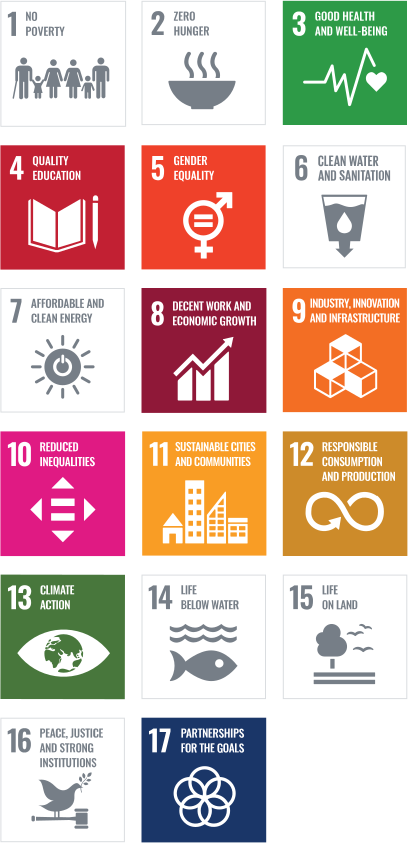
The 17 UN Sustainable Development Goals (SDGs) provide a shared blueprint for peace and prosperity for people and planet, now and in the future. We understand we have a direct role to play in delivering many of the SDGs through our corporate culture, sustainability strategy, and our Cement beyond Carbon vision. As part of this, we have identified* those SDGs where our initiatives and business operations have the most significant potential to contribute to sustainability efforts:

We report according to the ESG reporting standard for stock listed companies in the EU. Our Non-Financial Group Reports (NFRD standard), including the EU Taxonomy Report, can be found here.
EU Taxonomy
The EU Taxonomy is a green classification system designed to evaluate the environmental performance of specific economic activities. It provides a way for us to determine whether our business activities align with sustainability goals. We currently offer seven products that qualify as Taxonomy-eligible of which two are Taxonomy-aligned.
Taxonomy-eligible products*:
Roller press (incl. separators), Pyrorotor®, Oxyfuel, KHD ProMax® RTO, clay calcination, WHRS (waste heat recovery systems), sale of spare parts
Taxonomy-aligned products*:
Roller press (incl. separators), Pyrorotor®, Oxyfuel, KHD ProMax® RTO, clay calcination, WHRS (waste heat recovery systems)
KHD products are classified contributing to:
*status as of NFRD report 2025
2025 Taxonomy KPI’s
| Total | Taxonomy-eligible | Taxonomy-aligned | |
|---|---|---|---|
| Revenues in thousand EUR | EUR 177,922 | EUR 83,043 | EUR 44,566 |
| in % | 46.7% | 25.1% | |
| 2024 in % | 36.7% | 15.4% | |
| Capital Expenditures (CapEx) in thousand EUR | EUR 8,024 | EUR 1,695 | EUR 1,695 |
| in % | 21.1% | 21,1% | |
| 2024 in % | 0% | 0% | |
| Operational Expenditures (OpEx) in thousand EUR | EUR 9,235 | EUR 3,854 | EUR 3,854 |
| in % | 41.7% | 41.7% | |
| 2024 in % | 30.0% | 30.0% |
CSR figures – year on year comparison (in EUR thousand)
A rating score provides guidance on the prioritized ESG aspects and frameworks of sustainability reporting.
Ratings can only be an initial indicator for a meaningful assessment. The constraints of a sustainability assessment via rating scores are limited methodological transparency and inconsistent evaluation criteria.
The sustainability performance of KHD focuses on the material topics, which have been determined as part of a multi-stage analysis based on the principle of double materiality according to ESRS standard. Further information on ESG risk management, strategy and organization is reported in the CSR-Report with details of concepts, measures and key figures.
EcoVadis Rating
KHD is rated by EcoVadis, an ESG rating specialized in supply chains, which is mainly used in the B2B sector to better manage suppliers’ sustainability risks in procurement.
KHD HUMBOLDT WEDAG INTERNATIONAL AG (GROUP)
Scoring Scale: Good
Structured and proactive sustainability approach. Engagements/policies and tangible actions on major issues. Basic reporting on actions, Key Performance Indicators.
Highlights
Sustainable Procurement
KHD HUMBOLDT WEDAG INTERNATIONAL AG (GROUP) is in the top 26% of companies rated by EcoVadis in the sector: Manufacture of special-purpose machinery.
Ethics
KHD HUMBOLDT WEDAG INTERNATIONAL AG (GROUP) is in the top 29% of companies rated by EcoVadis in the sector: Manufacture of special-purpose machinery.

To comply with relevant legal and regulatory requirements is a prerequisite for KHD Group’s license to operate. With increasing complexity of technology and the dynamic landscape of risks, solid Governance is becoming more and more important. Governance provides the factual and legal frameworks for directing our activities, encompassing our culture, organizational structure, guidelines, resources, and processes.
Governance for KHD Group goes beyond frameworks and organizational borders. It is a common approach of all stakeholders to creating a culture of integrity, transparency, and accountability, understanding guidelines, and living up to them. Sustainability at KHD Group is managed through an integrated Governance, Risk, Compliance (GRC) framework addressing material topics along the three dimensions: Environment- Social- Governance. Systematic ESG risk management helps us identify and address strategic priorities at an early stage. A Group-wide compliance and due diligence approach ensures that KHD Group products and operations meet applicable legal and regulatory requirements, recognized frameworks and industry standards. Governance enables the implementation of ESG Program priorities and covers key topics such as ethics and integrity, anti-corruption and anti-bribery, fair competition and whistleblower protection.
Group Policies include our Code of Conduct, Supplier Code of Conduct, HSE Policy, Human Rights Policy, Quality Policy and annual corporate governance and declaration of compliance disclosures.
Our standards apply equally to employees, customers, suppliers and all business partners, forming a shared foundation for responsible collaboration.
This Code of Conduct defines the standards of ethical behavior required of all employees of KHD Group. We are committed to loyalty, the concept of fair practice and are aware of our responsibility towards society and the environment.
| Code of Conduct |
The Supplier Code of Conduct incorporates our corporate values and serves as a compass to guide our daily interaction with our suppliers around the world. Part of our risk management and compliance system is the Integrity Line, which allows stakeholders to submit complaints and information related to suspected violations of the Supplier Code of Conduct.
| Supplier Code of Conduct |
Upholding internationally recognized human rights across our operations and value chains is non-negotiable for KHD Group. The Human Rights Policy is guided by the UN Guiding Principles on Business and Human Rights and supported by our due diligence processes. We aim to prevent adverse human rights impacts, promote fair and safe working conditions and foster a culture of transparency, respect and accountability.
At Group level, a Human Rights Officer ensures compliance oversight and coordinates governance and due diligence mechanism. Relevant national frameworks including the POSH Act in India, are implemented on entity level.
| Group Human Rights Policy |
For uncompromised health and safety for people, environment, and products, the KHD Group HSE Policy provides guidance for preventing and mitigating any kind of accident and incident across our value chain and beyond in accordance with globally accepted standards of ISO 45001 and ISO 14001.
| Group HSE Policy |
Responsible innovation for KHD Group must equally fulfil high standards of quality, safety and integrity of products, services and processes. KHD Group Quality Policy* defines the benchmark for continuous improvement and enhancement.
*KHD Group operating companies are certified according to ISO 9001, a level playing field for comparable standards globally.
| Group Quality Policy |
When it comes to sustainability, no individual company or organization has all the answers. We believe that achieving it will instead be a collective effort and that partnerships are, therefore, essential. Such partnerships enable us to share knowledge and best practices, leverage good governance and business principles, and enhance transparency, communication, and trust.
Here at KHD, we actively support collaborations with other industry leaders, research institutions, and non-governmental organizations to develop and implement sustainable solutions and address broader sustainability challenges.
United Nations Global Compact
We are a participant of the United Nations Global Compact (UNGC). As such, we are committed to upholding the Ten Principles of the UNCG in the areas of human rights, labor, environment, and anti-corruption. Each year, we publish a Communication on Progress (CoP), detailing our ongoing efforts and achievements in sustainable practices. Explore our UNGC public profile to learn more about our initiatives and impact.